Qalverunoxel
Free Sphere
Free Sphere
Couldn't load pickup availability
1. Problem Statement
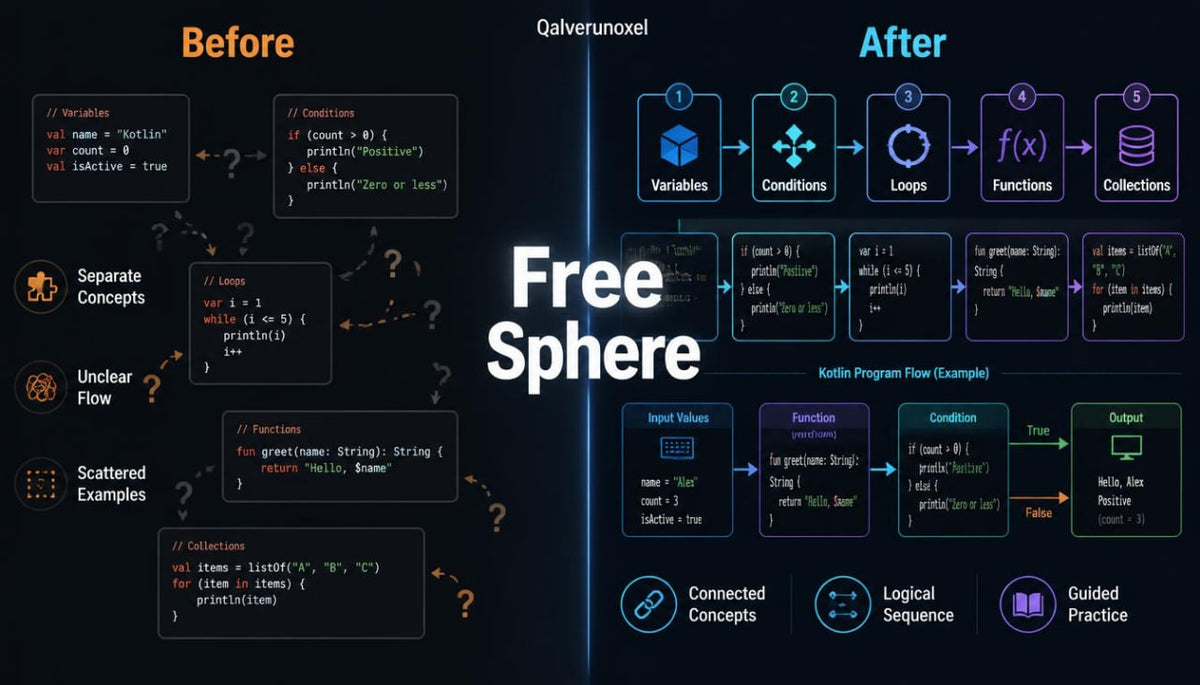
Programming concepts can feel disconnected when rules appear without context. A learner may recognize a variable or conditional expression but still find it difficult to decide where that element belongs in a program. Syntax details can distract from the underlying logic. Without opportunities to test ideas in context, unfamiliar concepts may remain abstract. Introductory materials should connect these elements through manageable activities.
2. Solution
Free Sphere presents Kotlin as a sequence of connected ideas. Each topic connects its purpose with examples and exercises. Learners work with short code segments, observe how values change, and consider why specific statements behave as they do. Guided tasks encourage experimentation with conditions, loops, collections, and functions. A concluding activity combines concepts into one program.
3. What's Inside
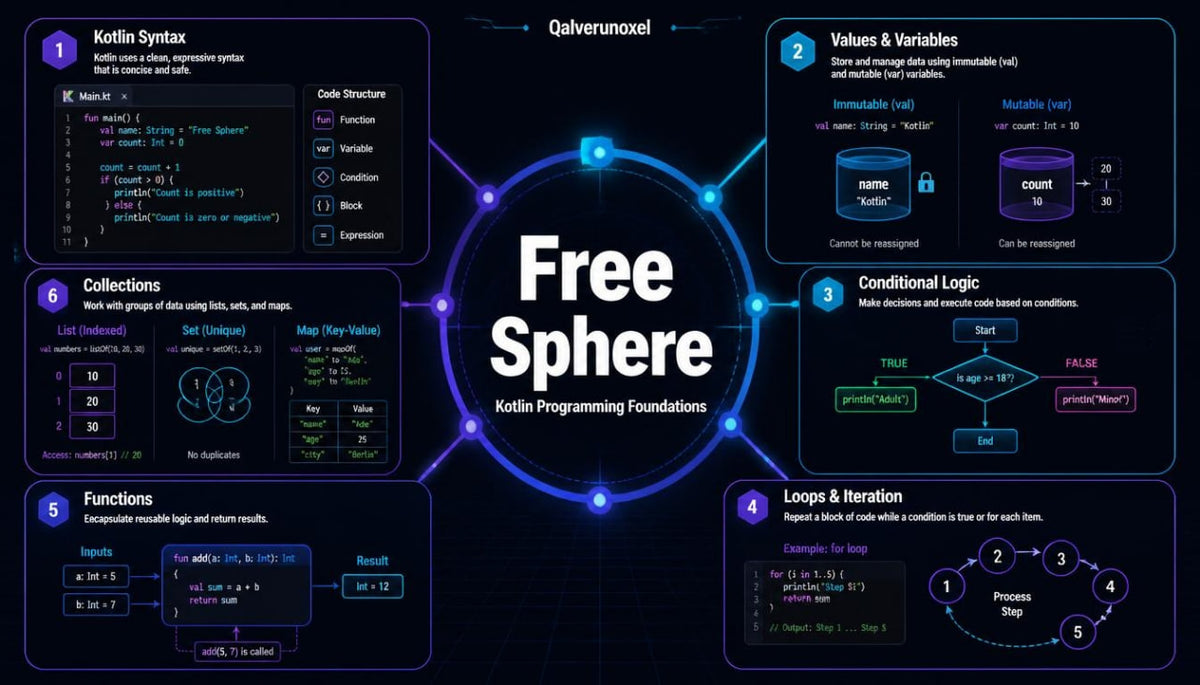
Module 1 — Reading Kotlin Code
Identify expressions, statements, braces, indentation, and comments while examining the structure of a short program.
Module 2 — Values and Variables
Compare immutable and mutable declarations, examine common data types, and practice assigning values with meaningful names.
Module 3 — Expressions and Decisions
Explore arithmetic and comparison operations, Boolean expressions, and conditional branches through examples with different inputs.
Module 4 — Repetition and Flow
Follow loop execution, trace changes across iterations, and identify stopping conditions in simple tasks.
Module 5 — Functions and Parameters
Read function declarations, pass arguments, return values, and divide one task into smaller units.
Module 6 — Collections and Simple Data Handling
Explore lists and sets, retrieve elements, iterate over grouped values, and distinguish common collection operations.
Module 7 — Guided Practice
Complete short exercises involving input values, branching rules, repeated calculations, and reusable functions.
Module 8 — Closing Activity
Assemble a small text-based data organizer, review its logic, and consider changes that would make the code easier to read.
4. Who Is This For?
Free Sphere is intended for people beginning their study of Kotlin and for learners who want to revisit foundational programming ideas. It may also suit readers comparing programming structures across languages. No previous Kotlin knowledge is assumed. The material is designed for independent reading and practice at a personally chosen pace.
5. What You'll Learn
-
Recognize common Kotlin syntax and distinguish statements from expressions.
-
Declare values and variables and select suitable basic data types.
-
Build conditional logic using comparisons and Boolean operators.
-
Trace loops and explain how iteration changes program state.
-
Define functions with parameters and return values.
-
Work with basic collections and organize a small program into readable parts.
6. Guarantee
Free Sphere is provided without a purchase. The following refund policy concerns paid courses only.
We offer a 30-day money-back guarantee on all paid digital courses and educational materials available through our store.
If you are not satisfied with your purchase, you may request a full refund within 30 calendar days of the original purchase date.
As our courses are delivered digitally, there is no need to return any physical items. Receiving, downloading, or opening the course materials does not affect your eligibility for a refund under this policy.
Refunds will be issued to the original payment method. Processing times may vary depending on your bank or payment provider.
How are Qalverunoxel courses organized?
How are Qalverunoxel courses organized?
Our Kotlin courses are organized around individual programming topics and structured learning modules. Each course includes written explanations, code examples, and practical activities that encourage independent exploration of the material.
Do I need previous programming knowledge?
Do I need previous programming knowledge?
The recommended starting point depends on the selected course. Introductory materials explain foundational concepts, while later courses examine more detailed programming structures. Each course description outlines its intended audience and learning topics.
What format do the educational materials follow?
What format do the educational materials follow?
Our courses are delivered digitally and contain written educational materials, structured modules, programming examples, and practical exercises. The content is arranged for independent reading, review, and study.
Share