Qalverunoxel
Lattice Guide
Lattice Guide
Couldn't load pickup availability
1. Problem Statement
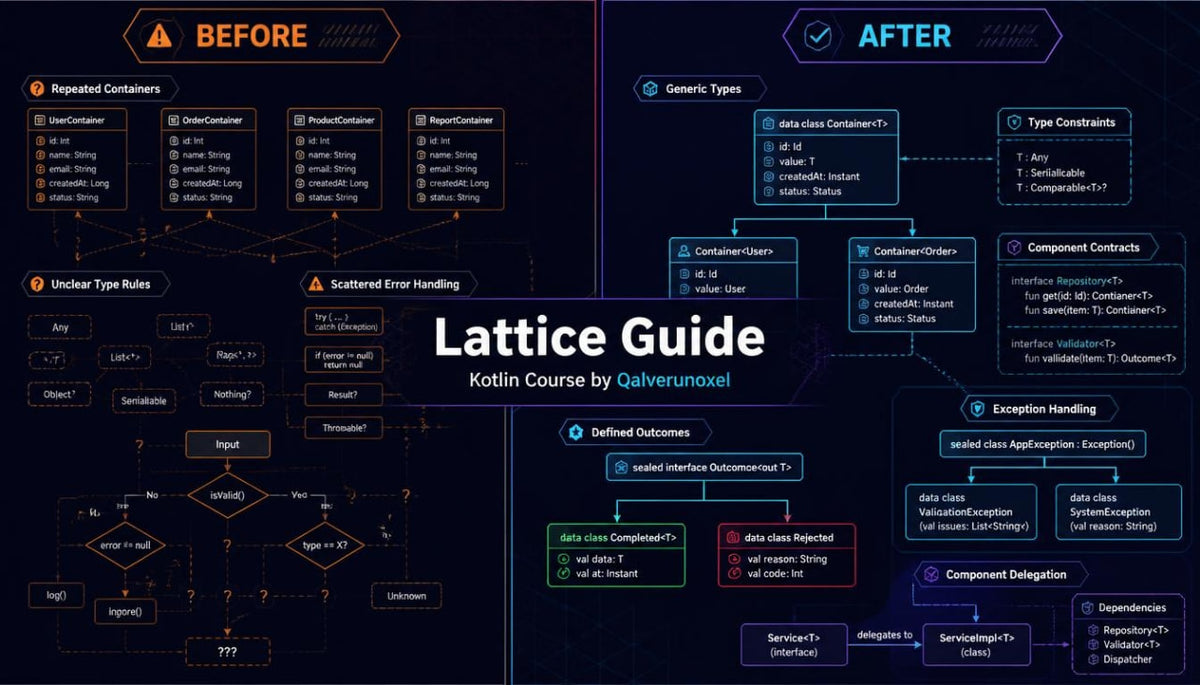
As programming tasks involve additional data types and components, repeated structures can become difficult to maintain. Learners may understand individual classes but struggle to design relationships that remain clear when requirements change. Incorrect type assumptions can introduce behavior that is difficult to trace. Error conditions also require thoughtful handling rather than scattered conditional checks. These difficulties make it useful to study how Kotlin represents shared behavior, type constraints, and exceptional situations.
2. Solution
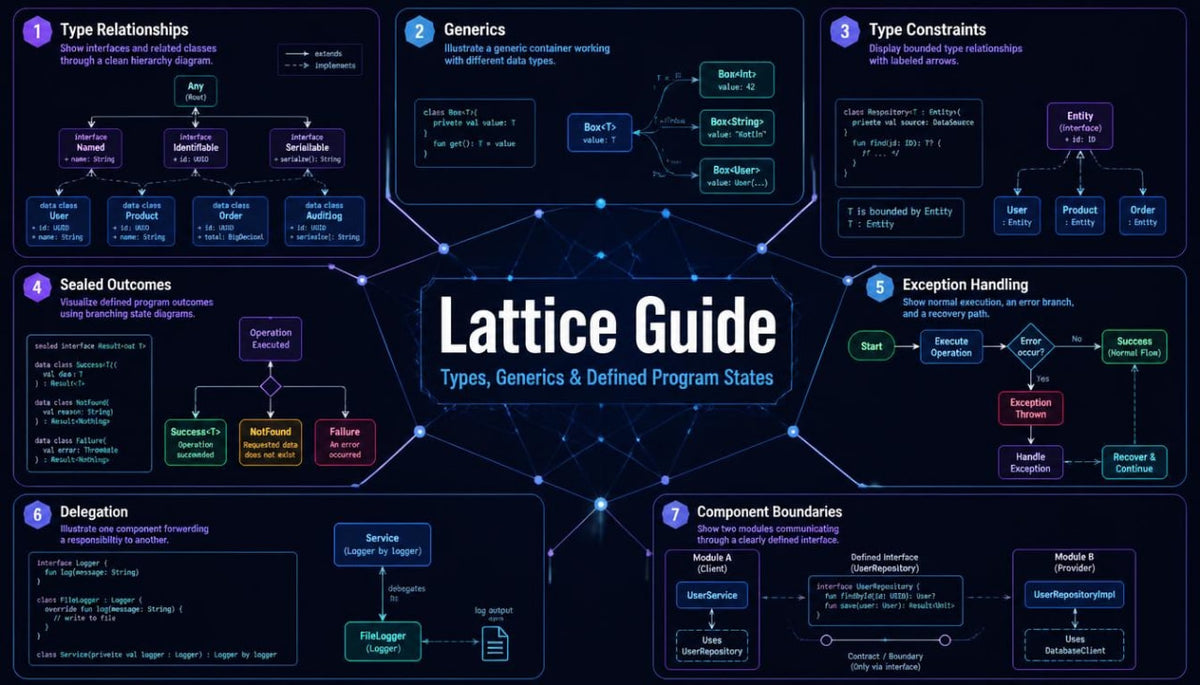
Lattice Guide organizes these subjects into a sequence of focused technical lessons. Each module introduces a structural concept through annotated examples and coding tasks. Learners compare alternative representations of data and examine their tradeoffs. Guided exercises connect generic types, defined state models, and error handling within reusable components. A final workshop combines the material into a small program with documented boundaries and test cases.
3. What's Inside
Module 1 — Reading Type Relationships
Review class hierarchies, interfaces, and type checks. Trace how declared types influence permitted operations and move through function calls.
Module 2 — Generics in Practice
Define generic classes and functions, introduce type parameters, and compare reusable containers with separate implementations for different data types.
Module 3 — Type Constraints and Variance
Examine bounded type parameters and variance declarations. Use examples to reason about values that components can receive or return.
Module 4 — Data Models and Defined States
Combine data classes with sealed structures to represent different outcomes. Practice distinguishing valid states from incomplete or conflicting records.
Module 5 — Exceptions and Recovery Paths
Study exception handling, custom exceptions, and cleanup behavior. Compare reporting failures through exceptions with returning structured outcomes.
Module 6 — Delegation and Property Behavior
Explore interface delegation, delegated properties, and observable changes. Identify situations where delegation reduces repeated code while preserving clarity.
Module 7 — Reviewing Component Boundaries
Inspect examples containing mixed responsibilities, duplicated validation, and unclear naming. Reorganize functions and types into focused components.
Module 8 — Applied Structure Workshop
Build a record-validation routine using generic containers, state models, and error paths. Test varied inputs and document component responsibilities.
4. Who Is This For?
Lattice Guide is designed for learners familiar with Kotlin classes, functions, collections, and lambda expressions. It suits readers interested in type relationships, reusable components, and error handling through practical exercises. Previous experience organizing small programs is recommended.
5. What You'll Learn
-
Define generic functions and classes with type parameters.
-
Interpret type constraints and variance declarations.
-
Model defined outcomes with sealed structures.
-
Distinguish exception handling from structured error results.
-
Apply delegation to appropriate programming tasks.
-
Review component responsibilities and reduce repeated logic.
-
Test data validation paths with varied inputs.
6. Guarantee
We offer a 30-day money-back guarantee on all paid digital courses and educational materials available through our store.
If you are not satisfied with your purchase, you may request a full refund within 30 calendar days of the original purchase date.
As our courses are delivered digitally, there is no need to return any physical items. Receiving, downloading, or opening the course materials does not affect your eligibility for a refund under this policy.
Refunds will be issued to the original payment method. Processing times may vary depending on your bank or payment provider.
How are Qalverunoxel courses organized?
How are Qalverunoxel courses organized?
Our Kotlin courses are organized around individual programming topics and structured learning modules. Each course includes written explanations, code examples, and practical activities that encourage independent exploration of the material.
Do I need previous programming knowledge?
Do I need previous programming knowledge?
The recommended starting point depends on the selected course. Introductory materials explain foundational concepts, while later courses examine more detailed programming structures. Each course description outlines its intended audience and learning topics.
What format do the educational materials follow?
What format do the educational materials follow?
Our courses are delivered digitally and contain written educational materials, structured modules, programming examples, and practical exercises. The content is arranged for independent reading, review, and study.
Share