Qalverunoxel
Trail Pathway
Trail Pathway
Couldn't load pickup availability
1. Problem Statement
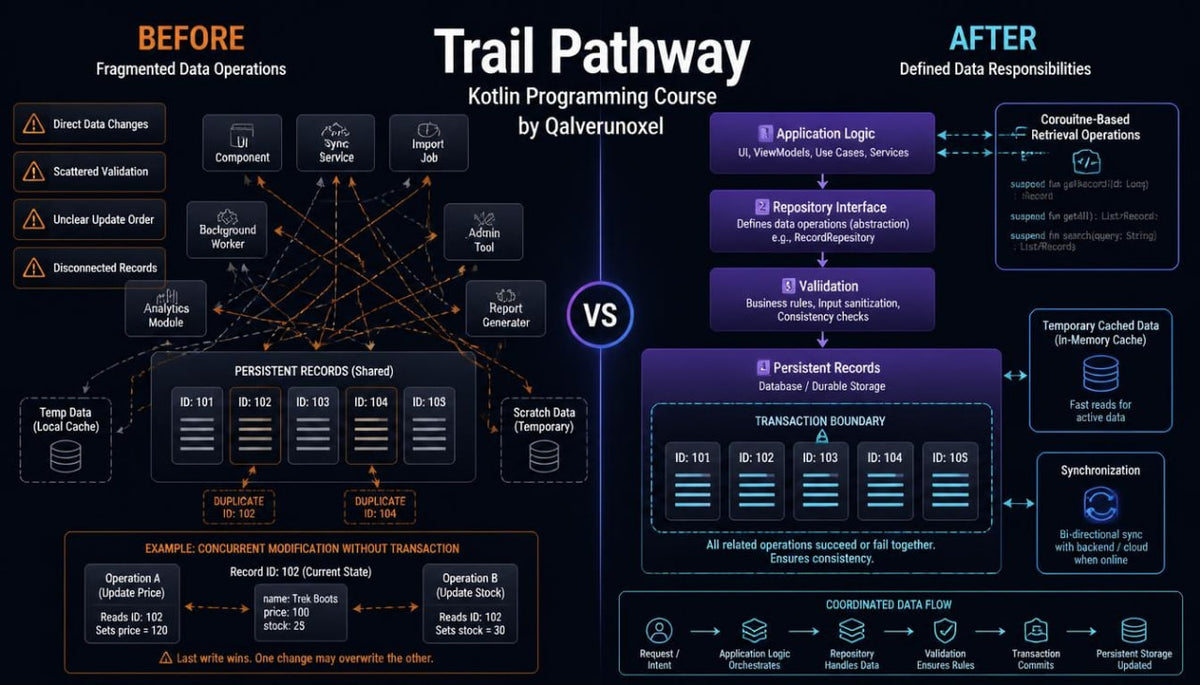
As Kotlin applications manage growing collections of information, organizing data operations becomes increasingly complex. Learners may understand classes and functions but encounter difficulties connecting application logic with persistent records. Inconsistent validation rules can cause different components to interpret the same information differently. Concurrent updates introduce further challenges when several operations modify related records. These situations require careful examination of data boundaries, storage responsibilities, and coordinated program behavior.
2. Solution
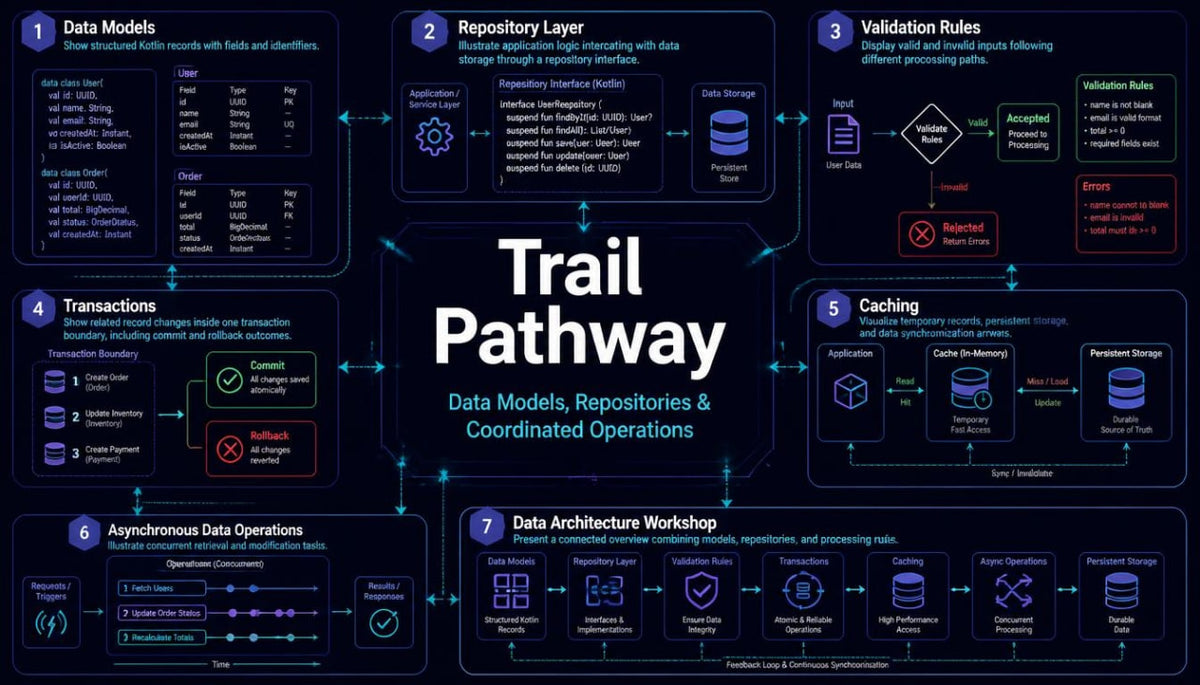
Trail Pathway introduces data-oriented application design through structured Kotlin examples. Each module examines how information is represented, validated, stored, and retrieved within connected components. Learners compare data organization approaches and study how repository interfaces separate application rules from storage operations. Practical exercises explore transactional updates, caching decisions, and asynchronous data handling. The concluding workshop combines these concepts into a small record-management application with documented data flows.
3. What's Inside
Module 1 — Mapping Application Data
Examine how information moves between application components. Identify data sources, processing stages, and boundaries between temporary and persistent records.
Module 2 — Designing Kotlin Data Models
Create structured representations using data classes, nullable properties, and defined identifiers. Explore relationships between records and their associated values.
Module 3 — Repository Structures
Study repository interfaces and implementation responsibilities. Practice separating data retrieval operations from application rules and validation procedures.
Module 4 — Validation and Data Integrity
Define validation rules for incoming information. Examine missing fields, duplicate identifiers, invalid relationships, and structured error responses.
Module 5 — Transactions and Consistent Updates
Explore coordinated modifications involving related records. Examine transaction boundaries, rollback behavior, and scenarios involving incomplete operations.
Module 6 — Caching and Data Synchronization
Compare temporary cached information with persistent records. Study cache expiration, outdated values, and strategies for maintaining consistent data representations.
Module 7 — Asynchronous Data Operations
Connect coroutine concepts with data retrieval and modification. Examine cancellation, concurrent updates, and controlled communication between program components.
Module 8 — Applied Data Architecture Workshop
Create a small Kotlin record-management application involving repositories, validation rules, transactional operations, and asynchronous tasks. Review its structure through practical test cases.
4. Who Is This For?
Trail Pathway is intended for learners familiar with Kotlin classes, interfaces, collections, coroutines, and modular application structures. It suits individuals interested in data organization, persistent records, and coordinated operations within connected components. Previous experience with structured error handling and basic testing is recommended.
5. What You'll Learn
-
Design Kotlin data models for structured records.
-
Define repository interfaces and implementation boundaries.
-
Organize validation rules for incoming information.
-
Explain transaction behavior and rollback scenarios.
-
Compare caching approaches and synchronization requirements.
-
Coordinate asynchronous data operations.
-
Identify conflicts involving concurrent record updates.
-
Build a small application with organized data responsibilities.
6. Guarantee
We offer a 30-day money-back guarantee on all paid digital courses and educational materials available through our store.
If you are not satisfied with your purchase, you may request a full refund within 30 calendar days of the original purchase date.
As our courses are delivered digitally, there is no need to return any physical items. Receiving, downloading, or opening the course materials does not affect your eligibility for a refund under this policy.
Refunds will be issued to the original payment method. Processing times may vary depending on your bank or payment provider.
How are Qalverunoxel courses organized?
How are Qalverunoxel courses organized?
Our Kotlin courses are organized around individual programming topics and structured learning modules. Each course includes written explanations, code examples, and practical activities that encourage independent exploration of the material.
Do I need previous programming knowledge?
Do I need previous programming knowledge?
The recommended starting point depends on the selected course. Introductory materials explain foundational concepts, while later courses examine more detailed programming structures. Each course description outlines its intended audience and learning topics.
What format do the educational materials follow?
What format do the educational materials follow?
Our courses are delivered digitally and contain written educational materials, structured modules, programming examples, and practical exercises. The content is arranged for independent reading, review, and study.
Share